
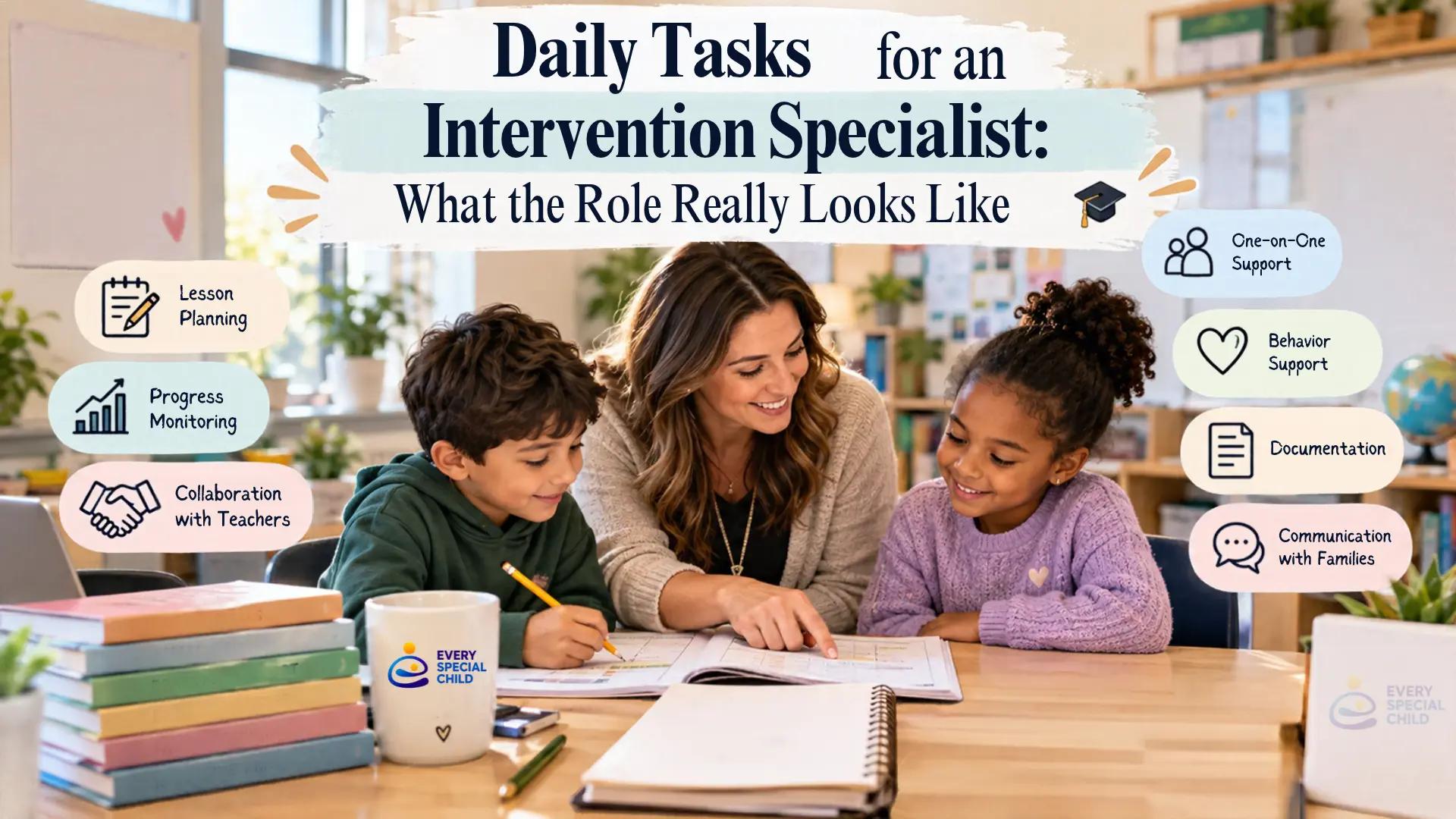
A Realistic View of the Role of a Daily Tasks for Intervention Specialist
Daily Tasks for Intervention Specialist If you are thinking about a career in special education, you will have a much better understanding of what an intervention specialist does on a daily basis.
Teaching lessons is rarely the only part of an intervention specialist’s day. Direct student instruction, specialized educational support, IEP-related tasks, progress tracking, lesson planning, classroom cooperation, family communication, and continuous documentation are all frequently included in this role.
The exact tasks can vary from one educational system to another. The position’s daily appearance can be influenced by a number of factors, including grade level, student needs, staffing models, state regulations, and the special education program’s structure.
Despite these variations, the general goal remains the same: assisting students in gaining access to instruction, advancing their education, acquiring practical skills, and effectively engaging in their learning environment.
Knowing how these duties work together will help anyone considering a career as a Special Education Intervention Specialist better grasp the demands of the position. Apply Now
What Does an Intervention Specialist Do?
An educator who works with students who need specific academic, behavioral, developmental, or learning support is known as an Daily Tasks for Intervention Specialist.
Similar roles may use titles like these, depending on the state, district, or school:
- Teachers of special education
- Education specialists
- Resource teachers
- Learning support teachers
- Intervention teachers
Despite having different job titles, several of these occupations have comparable duties.
Job duties for an Daily Tasks for Intervention Specialist could include the following:
- Teaching pupils in small groups or alone
Intervention Specialist Professionals’ Daily Tasks
Instead of a single, continuous teaching task, a normal school day may involve multiple different kinds of work.
Daily Tasks for Intervention Specialist might, for instance, start the day by going over student objectives, leading a reading group, helping students in a general education classroom, keeping track of progress, meeting with another teacher, creating materials that have been modified, and then taking part in an IEP meeting.
The role is rigorous and varied because it involves teaching, planning, teamwork, and documentation. See More Other
Preparing for the Arrival of Students
Prior to the start of instruction, the early hours of the day frequently offer a chance to arrange priorities.
An Daily Tasks for Intervention Specialist may examine:
- Schedules for students
- IEP objectives
- Lesson plans
- Future exams or evaluations
- Classroom accommodations
- Meetings that are scheduled
- Information on behavioral assistance
- Plans for intervention
- Resources required for teaching
When a teacher works with multiple children from different classes or grade levels, this planning is quite helpful.
A quick check-in with general education teachers, paraprofessionals, or other staff members may also take place in the morning. These brief discussions might help explain scheduling modifications, crucial student information, or the assistance required throughout the day. See More
Providing Specialized Instruction
Direct instruction is a big part of many jobs for Daily Tasks for Intervention Specialists.
The way instruction happens can vary depending on what the students need and how the school provides support.
Some possible places where instruction might take place include:
- One-on-one teaching sessions
- Small group teaching
- Resource classrooms
- Regular classrooms
- Co-teaching situations
- Support provided directly in the classroom
- Intervention time set aside in the schedule
The areas that are taught or supported can be different for each student.
Students might get help in areas like:
- Reading
- Writing
- Math
- Communication
- Organization
- Planning and managing tasks
- Social skills
- Basic life skills
- Study habits
- Completing tasks
An Daily Tasks for Intervention Specialist might try a different way to teach something if a student needs it.
For example, the teacher might go slower, use more examples, include pictures, give more practice, break activities into smaller steps, or let the student show their learning in a new way.
Making things easier is not the only objective.
Specialized instruction is meant to help students learn better and become more independent over time.
Adapting Lessons for Different Learners
Students in special education may aim for the same learning goals as their classmates, but they might need different ways to reach those goals.
That’s where instructional adaptation becomes important.
An Daily Tasks for Intervention Specialist may:
- Break long instructions into smaller steps
- Use pictures or visual directions
- Create graphic organizers
- Change reading materials
- Show a task before asking students to do it
- Use hands-on materials
- Give extra practice with guidance
- Allow different ways to answer questions
- Change assignments when needed
- Use helpful technology
- Give clear prompts
The best strategy depends on the student.
Adaptations should match the student’s needs, the classroom rules, and the services listed in their IEP.
IEP Duties of an Daily Tasks for Intervention Specialist
IEP responsibilities are an important part of many Daily Tasks for Intervention Specialist jobs.
Some Daily Tasks for Intervention Specialist also act as case managers.
In that role, they help organize student information, check that services are given, track how the student is doing, talk with other team members, and prepare for IEP meetings.
Reviewing Current Student Performance
To plan educational goals well, the team needs to know what the student is currently able to do.
An Daily Tasks for Intervention Specialist may collect information about:
- Academic skills
- How much they participate in class
- Communication skills
- Behavior
- How well they do tasks on their own
- Developmental needs
- What they can do independently
This helps the team see what the student is good at and where more help is needed.
Helping Create Measurable Goals
Daily Tasks for Intervention Specialist help write IEP goals that match what the student needs.
Good goals are ones that can be seen and measured over time.
The exact goal depends on the student, but the goal is to set useful targets that help with teaching and tracking progress.
Supporting IEP Accommodations
Once supports are written in the IEP, teachers are responsible for making sure they are used during lessons and tests.
Depending on the student’s plan, accommodations may include:
- More time to finish tasks
- Testing in small groups
- Visual help
- Preferred seating in class
- Assistive technology
- Modified assignments
- Set steps to follow
Daily Tasks for Intervention Specialist often help teachers understand how these supports can be used every day in the classroom.
Monitoring Progress on IEP Goals
IEP goals need to be checked regularly.
An Daily Tasks for Intervention Specialist may gather information through student work, test results, classroom observations, behavior reports, skill checks, or other ways that relate to a specific goal.
This helps to see if the student is improving and whether the current teaching methods are working.
Participating in IEP Meetings
Daily Tasks for Intervention Specialist may take part in IEP meetings and share what they know about the student’s learning.
Discussion may include:
- How well the student is doing in school
- How much progress they’re making toward goals
- How much they participate in class
- Areas where they need more help
- What teaching methods are working
- What supports the student needs
- What the intervention has achieved
- What the student’s future education should focus on
Families and other educators may also share their thoughts to help the team decide on the best plan for the student.
Monitoring Student Progress
Collecting data is important for teaching.
Teachers need information to know if a certain method, technique, or lesson is helping a student.
Progress information can come from:
- Curriculum-based measures
- Reading assessments
- Math skill checks
- Writing samples
- Classwork
- Teacher observations
- Informal tests
- Behavior records
- IEP data
This information is more than just filling out forms.
When data shows a student is improving, the teacher can keep using or improve their current plan.
If progress isn’t happening, the teacher may need to change their approach.
Adjustments could involve using different materials, giving more practice, changing the level of help, trying a new teaching method, or adjusting how much support is given.
Supporting Students in Inclusive Classrooms
Daily Tasks for Intervention Specialist spend time in regular classrooms.
In an inclusive environment, students get help while joining in with other students instead of getting all their learning in a separate place.
An Intervention Specialist can support inclusion by:
- Teaching with other teachers
- Helping a small group
- Explaining instructions again
- Reviewing skills from before
- Helping students organize their work
- Providing accommodations
- Checking if students understand
- Encouraging classroom participation
- Helping students do tasks on their own
One main goal is to give enough help so students can take part without needing too much adult help all the time.
Good inclusion often depends on communication between all the people helping the student.
Working With General Education Teachers
Teamwork is important in special education.
Since many students learn from many teachers during the day, sharing information helps teachers give a more consistent experience.
Daily Tasks for Intervention Specialist might talk with general education teachers about:
- What the student is good at
- What the student needs help with
- IEP accommodations
- Upcoming lessons
- Testing needs
- How the student is doing in class
- Teaching methods
- Behavior issues
- How the student is progressing
- What will happen next
For example, if a teacher says a student is struggling with a new unit, the Daily Tasks for Intervention Specialist can think of extra help or changes that might help the student understand better.
Regular communication also helps teachers avoid using different or conflicting methods.
Supporting Behavioral and Social-Emotional Skills
Some students need help beyond just academic skills.
They may need support with paying attention, controlling emotions, behaving well, staying organized, working with others, or managing their time.
Depending on what the student needs, strategies can include:
- Visual schedules
- Rewards systems
- Scheduled breaks
- Self-check tools
- Checklists for staying organized
- Choosing options in a planned way
- Specific feedback on behavior
- Stories about social situations
- Routine activities that follow a pattern
The strategies used should match the student’s needs and the rules in school or their IEP.
It’s most helpful when these strategies teach students what to do instead of just pointing out what went wrong.
The long-term goal is to help students use these strategies more on their own over time.
Coordinating With Paraprofessionals
In some classrooms, paraprofessionals or aides help students.
Daily Tasks for Intervention Specialist can help explain how that help should be given.
Topics may include:
- Daily tasks
- Small group teaching
- Classroom rules
- How to manage behavior
- Progress reports
- Independent work
- Accommodations
- Transitions between activities
Clear instructions help everyone who works with the student understand the reason for the support.
It’s also important that adult help doesn’t accidentally stop the student from learning to do things themselves.
Communicating With Parents and Caregivers
Families can share information that teachers might not see during the school day.
Parents and caregivers can tell about a student’s interests, strengths, routines, how they communicate, challenges, and how they’re doing outside school.
Daily Tasks for Intervention Specialist may talk with families about:
- Academic progress
- IEP meetings
- How the student is doing in class
- What areas need extra help
- What strategies are working
- Changes in the student’s performance
- Educational goals
- Upcoming meetings or tests
Communication with families should be respectful, easy to understand, professional, and focused on the student’s needs.
Working With Related-Service Professionals
Students who get special education services might work with many people.
Depending on what the student needs, the Daily Tasks for Intervention Specialist may work with:
- School psychologists
- Speech-language pathologists
- Occupational therapists
- Physical therapists
- Behavior specialists
- School counselors
- Nurses
- Administrators
Each person brings a different view.
For example, a speech-language pathologist might suggest ways to help a student learn to talk better during class activities.
An occupational therapist might suggest ways to help the student get better at doing school tasks.
When these professionals talk to each other, students are more likely to get help that works together instead of separate, unrelated services.
Lesson Planning and Instructional Preparation
Not all of an Daily Tasks for Intervention Specialist work happens when students are there.
Planning time can be used to:
- Look at student work
- Check how much progress they are making
- Make lessons that work for different learners
- Create visual tools
- Change assignments
- Group students for extra help
- Set up classroom activities
- Get ready to collect data
- Update student files
- Review what needs to be done for IEPs
Preparing in advance makes teaching more efficient.
Having materials ready also helps avoid delays when students need special help or support.
Maintaining Special Education Documentation
Keeping records is another key part of the job.
The type of records needed depends on the school, but they may include:
- IEP details
- Progress reports
- Service records
- Communication with families
- Student test results
- Meeting notes
- Examples of student work
- Behavior reports
- Intervention records
Schools may use different digital tools or systems for these records.
Daily Tasks for Intervention Specialists: They must know what their school or district expects.
Good records help with teaching decisions and special education rules.
Responsibilities That May Occur Throughout the Day
Daily Tasks for Intervention Specialist often switch between tasks instead of doing the same thing all day.
A day might include:
- Leading a reading session
- Helping with math lessons
- Assisting during independent work
- Making adapted materials
- Tracking student progress
- Helping with classroom changes
- Talking with another teacher
- Providing help from an IEP
- Doing a quick check of skills
- Supporting a behavior plan
Schedules can change suddenly because of tests, student needs, staff being absent, meetings, or other school events.
For this reason, being flexible is very important.
Skills That Are Useful for Intervention Specialists
Successful Daily Tasks for Intervention Specialist use a mix of skills like teaching, organizing, working with people, and analyzing information.
Useful skills include:
- Organization
- Communication
- Teaching that fits different needs
- Managing the classroom
- Looking at student data
- Knowing about IEPs (Individualized Education Programs)
- Working together with others
- Solving problems
- Managing time well
- Being flexible
Patience is helpful, but the job requires more than just being patient with students.
Intervention Specialists often need to look at how well students are doing, decide on teaching plans, keep records, work with many professionals, and talk clearly with families.
Being able to handle many tasks at once is especially useful.
Is Becoming an Intervention Specialist Right for You?
This job might suit teachers who like giving special attention to students and enjoy solving educational problems.
It could work for those who like:
- Working directly with students
- Changing lessons to match different learning needs
- Seeing how students improve
- Working with other teachers and staff
- Finding real solutions to learning problems
- Helping create classrooms where everyone can learn
- Making teaching plans that fit individual needs
However, it’s important to know that the job involves more than just teaching.
Depending on the position, teachers might need to balance teaching with meetings, checking on progress, keeping records, managing cases, working with others, and planning.
One of the most satisfying parts of the job for many teachers is watching students improve over time—whether they’re learning a new skill, becoming more independent, speaking up more confidently, or learning strategies that help them be successful in class.
Frequently Asked Questions
1. What are the main Daily Tasks for Intervention Specialist?
Common duties may include teaching special lessons, helping with IEPs, tracking student progress, changing lessons to fit different needs, helping in the classroom, working with other teachers, talking to families, and keeping educational records.
The exact tasks depend on the school, grade level, the way the program is set up, and the students’ needs.
2. What responsibilities does an Intervention Specialist typically have?
An Intervention Specialist may give direct lessons, make changes to help students learn better, track how students are doing, support behavior strategies, take part in IEP meetings, work with other education staff, talk to families, and keep student records.
3. What can be included in an Intervention Specialist job description?
Job descriptions often include teaching, assessing students, helping with IEPs, tracking progress, supporting in the classroom, working with others, planning interventions, keeping records, and managing student cases.
Some employers might add other tasks based on their special education program.
4. What IEP work might an Intervention Specialist complete?
Depending on the job, an Intervention Specialist might look at how students are doing now, help set learning goals, collect progress data, make changes for students, prepare reports on progress, help with services, and attend IEP meetings.
5. How does an Intervention Specialist support students in the classroom?
Support can involve teaching in a way that fits different needs, using special learning materials, teaching small groups, helping include students in regular classes, providing academic help, tracking progress, making changes for students, and using behavior strategies.
The level of support should match each student’s needs.
6. Is an Intervention Specialist the same as a Special Education Teacher?
The jobs may have similar tasks, but the titles, licenses, qualifications, and duties can be different depending on the school or state.
Applicants should check the requirements listed by the school or district offering the job.
7. How much of the day does an Intervention Specialist spend teaching?
There is no standard schedule.
Some jobs involve a lot of teaching, while others split time between helping in the classroom, working with small groups, planning, handling IEPs, meeting with others, collecting data, working with colleagues, and keeping records.
The schedule depends on the students being helped and the school’s special education program.
Conclusion
Understanding the daily tasks of an Daily Tasks for Intervention Specialist shows that this job is more than just teaching in a classroom.
A typical day might mix teaching special lessons, giving support to individual or small groups, helping include students in everyday classes, handling IEP tasks, checking on progress, planning lessons, talking to families, working with others, and keeping records.
Because these tasks often overlap, Intervention Specialists need good organization, knowledge of teaching, flexibility, strong communication skills, and the ability to use student data when making educational decisions.
For teachers thinking about becoming Intervention Specialists, developing skills in personalized teaching, IEP implementation, tracking progress, working with others, and teaching in inclusive ways can help set them up for success when working with students who have different learning needs.


Comments (…)